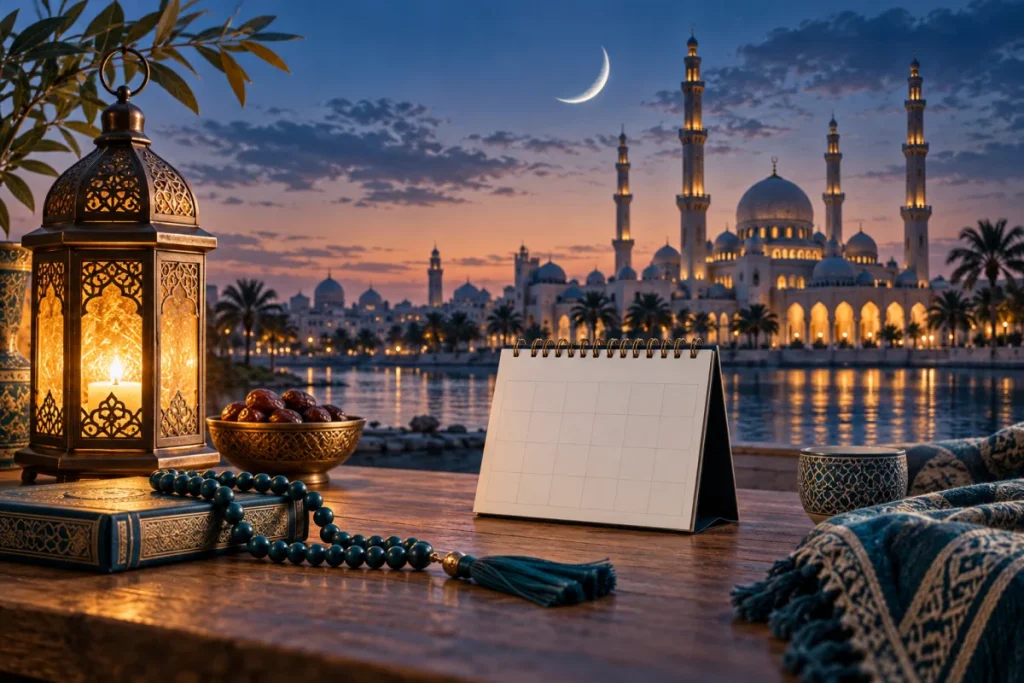
Muslim holidays follow the Islamic lunar calendar, so their Gregorian dates move each year. Some are joyful festivals, some are periods of worship or remembrance, and their legal public-holiday status differs from one country to another.
How the Islamic calendar affects holiday dates
The Hijri calendar has 12 lunar months and is about 10 or 11 days shorter than the Gregorian year. That is why Ramadan, both Eid festivals and other Islamic dates occur earlier in successive Gregorian years. Local authorities may confirm the start of a month through moon sighting, astronomical calculation or an official calendar.
For planning, use the date published by the responsible authority in the relevant country. A global estimate is useful for preparation but may not be the final local date.
Major Muslim holidays and observances
Ramadan
Ramadan is the month of fasting, prayer and charity. Adult Muslims who are able to do so fast from dawn to sunset. Working hours, school schedules and business opening times may change in many Muslim-majority countries even when every day of the month is not a public holiday.
Eid al-Fitr
Eid al-Fitr marks the end of Ramadan and begins on 1 Shawwal. Families attend prayers, share meals, give gifts and support charitable giving. Many countries provide one or more public-holiday days, but the number and closure rules vary.
Day of Arafah
The Day of Arafah occurs on 9 Dhu al-Hijjah, during the Hajj pilgrimage. It is a day of prayer and fasting for many Muslims who are not performing Hajj. Public-holiday treatment depends on local law.
Eid al-Adha
Eid al-Adha begins on 10 Dhu al-Hijjah and commemorates devotion and sacrifice. It is commonly observed with prayer, family gatherings, charitable distribution and several days of official leave in some countries.
Islamic New Year
The Islamic New Year is the first day of Muharram. Observance is often quieter than the two Eid festivals. Some countries designate it as a public holiday while others treat it as a calendar observance.
Ashura
Ashura falls on 10 Muharram. Sunni traditions often include voluntary fasting, while Shia communities commemorate Imam Husayn and the events of Karbala through mourning and remembrance.
Mawlid al-Nabi
Mawlid marks the birth of the Prophet Muhammad. It is widely observed in many countries, though traditions and public-holiday recognition vary and some Muslim communities do not celebrate it.
Laylat al-Qadr
Laylat al-Qadr, the Night of Power, is observed during the final nights of Ramadan. It is a major night of worship but is not automatically a public holiday.
Are Muslim holidays public holidays?
There is no single worldwide rule. National law, regional decisions and employer or school policies determine closures. Muslim-majority countries often recognize the Eid festivals and selected other dates, while minority-Muslim countries may not provide a general public holiday.
Planning for Islamic holidays
- Confirm dates in the country where the activity will occur.
- Check whether the notice covers government offices, banks, schools or private employers.
- Allow for reduced hours during Ramadan and busy travel periods around Eid.
- Avoid scheduling essential meetings without considering local observance.
Frequently asked questions
Why do Islamic holiday dates change?
They follow a lunar calendar rather than the Gregorian solar calendar.
Can the announced date differ by country?
Yes. Authorities may use different observation or calculation methods, and time zones also matter.
Which Muslim holidays are the largest celebrations?
Eid al-Fitr and Eid al-Adha are the two principal annual festivals, although other dates have deep religious importance.